Evaluating leads is where sourcing gets real. Finding a product is one thing. Knowing whether it is actually worth buying is another.
A good lead is not just something that looks profitable for five seconds in a calculator. You need to know whether you can sell it, whether the numbers hold up, whether it moves, and whether there are risks hiding behind the listing. Manually, that takes time. At scale, it can eat your whole day and ask for dessert.
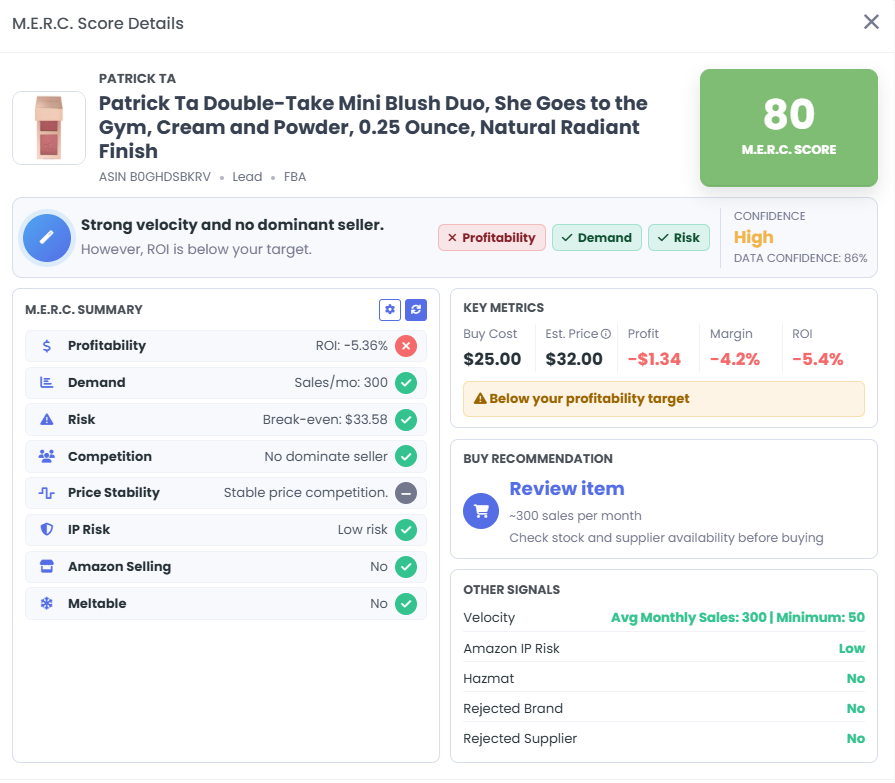
Start With The Obvious: Can You Sell It?
The first question is simple: are you allowed to sell the product?
Manually, you would check whether you are approved, restricted, gated, or blocked from listing the item. If you cannot sell it, the rest of the analysis does not matter yet. You may be able to apply for approval, but that is a separate decision.
3P Mercury helps automate this by surfacing sellability signals directly in the workflow, so restricted, rejected, hazmat, meltable, or otherwise problematic leads can be filtered out before you spend time reviewing them one by one.
Check Profitability Beyond The Surface
Profitability is not just sale price minus buy cost. You also need to account for the real costs involved:
- Cost of goods
- Amazon fees
- Inbound shipping
- Inbound placement fees
- Prep center fees
- FBM shipping, if applicable
- Any custom costs that affect the final profit
Manually, this means using a profit calculator and making sure the product meets your minimum ROI and margin requirements.
3P Mercury automates this by calculating profit, margin, ROI, and buy-cost assumptions in bulk. You can set rules like minimum ROI or minimum profit and quickly filter out leads that fail your targets.
Look At Break-Even Risk
A lead can look profitable today and become painful tomorrow if the price drops.
Manually, you should compare your break-even price against historical pricing. If the product usually sells well above your break-even point, the listing may have a safer cushion. If the average price regularly falls below break-even, that is a warning sign.
3P Mercury helps by showing whether the lead passes risk checks and whether current profitability has enough room to survive price movement.
Measure Demand And Velocity
Profit does not help much if the product does not sell.
Manually, sellers often look at Keepa data, BSR movement, monthly sales estimates, and seller-count drops. Keepa drops can still be useful, but they are less reliable than they used to be because Amazon has changed how sales rank behaves. When available, Amazon's average monthly sales data is usually a stronger signal.
3P Mercury automates demand review by bringing velocity signals into the lead evaluation. Instead of manually counting drops across thousands of products, you can filter by sales volume, demand strength, and minimum monthly movement.
Watch Price Stability And Competition
Stable pricing matters. A listing with consistent pricing and a reasonable seller count is usually easier to evaluate than one where the price swings wildly every time new sellers appear.
Manually, you would review:
- Historical buy box price
- Seller count changes
- Whether sellers are increasing or decreasing
- Whether price rises as sellers sell out
- Whether one seller appears to dominate the listing
3P Mercury condenses these signals into competition and price-stability checks, helping you spot listings with stable price behavior and no dominant seller.
Check Amazon, IP, Hazmat, Meltable, And Transparency Risk
Some leads fail because of risk, not math.
Manually, you need to check whether Amazon is selling the item, whether Amazon shares the buy box, whether there are IP-risk signals, whether the product is hazmat or meltable, and whether transparency codes may be required.
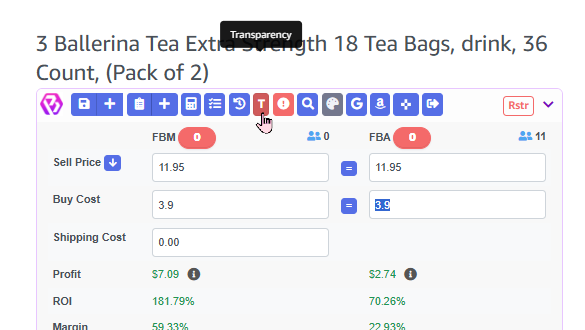
Transparency deserves special attention because a product may be enrolled in Amazon's transparency program even if the retail version you source does not include the required code. That can create problems when sending inventory to Amazon.
3P Mercury helps automate these risk checks so you can filter out leads with hazards before they become inventory problems.
Why Automation Matters
Doing this manually for one lead is possible. Doing it for 10,000 leads is where things get ugly.
Every listing may require several checks: profitability, break-even risk, velocity, Amazon presence, IP risk, seller competition, restrictions, hazmat, meltable status, transparency, supplier availability, and updated cost.
3P Mercury lets you apply preset filters, score leads, and narrow a huge list into a smaller group worth reviewing. You can filter for criteria like minimum ROI, minimum profit, not gated, not hazmat, not meltable, no rejected supplier, no rejected brand, and acceptable risk.
That means you spend less time digging through bad leads and more time validating the ones that actually deserve attention.
Final Takeaway
Evaluating leads manually teaches you what matters. Automating the process helps you scale it.
The goal is not to stop thinking. The goal is to stop wasting time on leads that already failed the basic checks. Use manual review to understand the why, then let 3P Mercury handle the repetitive filtering, scoring, and risk detection so you can focus on the final buying decision.
Simplify Your Reselling Workflow
Sign up for 3P Mercury to simplify your business. The one software that takes you from sourcing to shipping, automated with the power of AI.
Sign up for 3P Mercury