One profitable ASIN can feel like a breakthrough. Fifty reliable ASINs can feel like a business.
The problem is that none of them are permanent.
Suppliers run out of stock. Amazon joins a listing. Competition grows. Prices fall. Brands become restricted. A product gets discontinued, reformulated, or moved into a multipack that no longer matches your source. Even a great replenishable product can quietly stop being great.
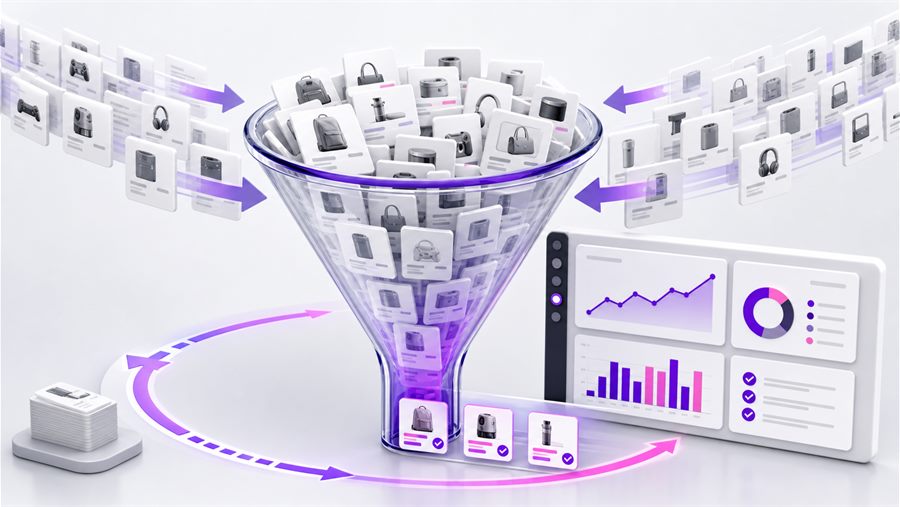
That is why sourcing cannot be something you do only when inventory gets low. Your Amazon lead funnel needs new, qualified products entering it every day.
The goal is not to buy every lead immediately. The goal is to build a large database of products with real demand and verified sources, then act when the market makes them worth buying.
Why Amazon Sellers Constantly Lose ASINs
Every lead database has attrition.
Some products disappear for reasons you can control:
- You failed to replenish them.
- The supplier link was never validated.
- The pack size was wrong.
- The product was not profitable after actual fees and returns.
Others disappear because the market changed:
- Amazon or a large seller entered the listing.
- Seller count increased and the price dropped.
- Your account became restricted from selling the brand or listing.
- The supplier stopped carrying the product.
- The supplier price increased.
- The product went out of stock.
- Demand weakened or became seasonal.
- An IP complaint or product-safety concern changed the risk.
If your business depends on a small collection of ASINs, losing a few can damage an entire month. A deeper funnel gives you somewhere else to go.
Think of it as inventory diversification. You do not need all saved products to be profitable today. You need enough qualified possibilities that changing conditions regularly create something worth buying.
What Belongs in a Qualified Lead Funnel?
A large database is not automatically useful. Loading 50,000 random ASINs into software does not create 50,000 opportunities. It may create 45,000 new ways to waste Tuesday.
A funnel lead should pass a basic qualification check before you save it.
The product has demand
Look for evidence that customers buy the product:
- Consistent sales-rank movement
- Meaningful monthly sales estimates
- Historical periods of strong velocity
- Repeated stock-outs followed by renewed sales
- A price and rank history that behaves like a real product, not a forgotten listing
Demand does not need to be perfect today. A seasonal item may have low current sales but a clear recurring peak. The important point is that the listing has shown an ability to move.
You can identify the exact product
Confirm:
- Brand
- Product name or model
- Size, color, flavor, or variation
- Unit count
- Multipack quantity
- UPC, model number, or other identifier when available
Bulk sourcing tools can return a single unit for a two-pack, a different size, or an entirely different product that happens to share a few words. Saving mismatches pollutes every calculation that comes after them.
The supplier is credible
The source should be a retailer, distributor, wholesaler, or other supplier you are comfortable buying from and defending if a marketplace asks for records.
Review:
- Business identity and contact information
- Physical location when relevant
- Reputation and customer complaints
- Product authenticity
- Return and cancellation policies
- Invoice or receipt quality
- Whether it appears to be a gray-market, liquidation, or returned-goods operation
A cheap product from a questionable source is not a strong lead. It is a future email you do not want to receive.
You can sell the listing
Check category, brand, and listing-level restrictions. A product may be excellent for another seller and useless to your account.
Eligibility can change, so a restricted product does not always need to be deleted permanently. But it should be clearly labeled so it does not repeatedly appear in purchasing reviews.
The risk is understandable
Look for:
- IP complaints
- Hazmat or dangerous-goods requirements
- Meltable restrictions
- Expiration dates
- High return rates
- Fragile or oversized shipping
- Brand or listing concerns
- Dominant Amazon presence
Some risks are acceptable when the reward is strong. The point is to identify them before the lead enters the buying queue.
For a deeper walkthrough, use the guide on how to source products properly with 3P Mercury.
Why Profit Does Not Matter Yet
This is the part that trips up many sellers: a funnel lead does not need to be profitable today.
Profit matters when you buy. It is not always required when you discover.
Imagine finding a product with steady demand and an exact source. At today's supplier price and Amazon Buy Box, it produces no profit. A typical sourcing tool rejects it, and you move on.
Three weeks later:
- The retailer runs a 30% promotion.
- Cashback increases.
- A discounted gift card becomes available.
- Amazon runs out of stock.
- Several FBA sellers leave.
- The Buy Box rises.
The product is now profitable, but only sellers who already researched it can react quickly.
This is market timing. The ASIN did not suddenly become a better product. The buying and selling conditions changed.
Discounts can change the cost
Online arbitrage costs may improve through:
- Store promotions
- Coupon codes
- Cashback portals
- Discounted gift cards
- Credit-card rewards
- Loyalty programs
- Quantity discounts
Wholesale products may improve through negotiated pricing, volume discounts, payment terms, freight arrangements, or closeout opportunities.
Competition can change the selling price
A product may become attractive when:
- Total seller count decreases
- FBA offers disappear
- Amazon goes out of stock
- Competitors run out of inventory
- The Buy Box rises
- Demand increases seasonally
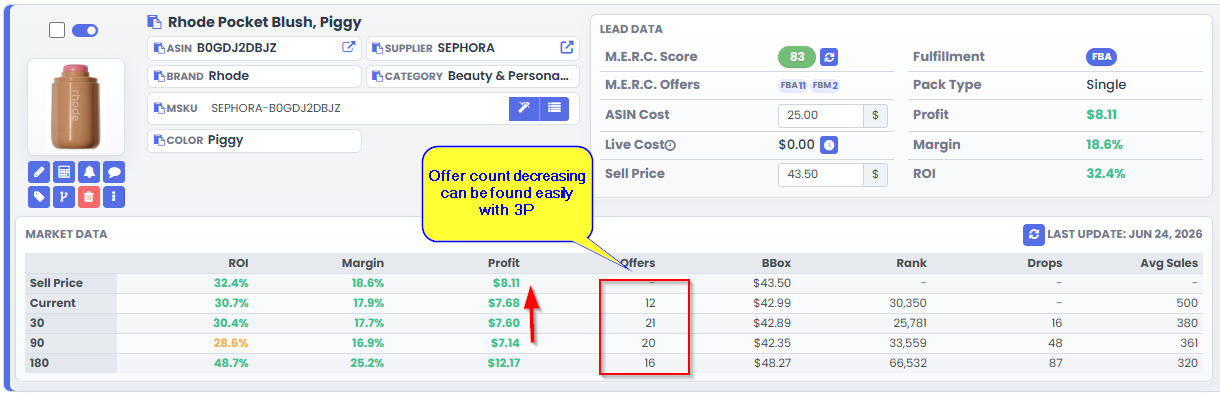
If you only save products that pass today's profit threshold, you lose the ability to catch tomorrow's pricing change.
Build a 50/50 Daily Sourcing Routine
The training recommends splitting sourcing effort into two jobs:
- Fill the funnel with qualified leads.
- Find products worth buying now.
A useful starting point is roughly 50% of sourcing time on each.
Funnel-building work
During this block, focus on discovery and validation:
- Find products with demand.
- Locate exact, credible sources.
- Confirm product matches and eligibility.
- Record supplier links and costs.
- Add tags for supplier, brand, season, or lead type.
- Save the lead even when current profit is weak.
Ways to find funnel leads include:
- Keepa Product Finder
- Manual supplier-site sourcing
- Amazon-to-supplier searches
- Storefront stalking
- Wholesale catalogs
- Lead lists
- Reverse sourcing software
- Rabbit trailing from a known product, brand, seller, or supplier
Automated tools can increase volume, but every imported result still needs validation. For a repeatable high-volume process, see how to find good leads in bulk with 3P Mercury.
Buy-now work
During the second block, focus on actual purchasing candidates:
- Replenish proven products first.
- Review saved leads that now pass your profit requirements.
- Look for lower competition and rising prices.
- Check supplier promotions and updated stock.
- Test promising new products conservatively.
This balance matters. Building a database forever without buying anything does not produce revenue. Buying without replacing lost leads eventually empties the pipeline.
Solo sellers can divide the day into two blocks. A team can divide the roles: one person continuously adds qualified leads while another reviews replenishments and purchase-ready opportunities.
Let 3P Mercury Reveal the Right Lead at the Right Time
A spreadsheet can remember where you found a product. It cannot easily monitor thousands of products and tell you which conditions changed.
3P Mercury tracks saved leads so you can filter for market signals instead of manually reopening every listing.
Useful opportunity filters can include:
- Decreasing seller count
- Low FBA offer count
- Amazon not selling
- Rising Buy Box
- Updated positive ROI
- Supplier stock available
- Live cost changes
- Strong sales velocity
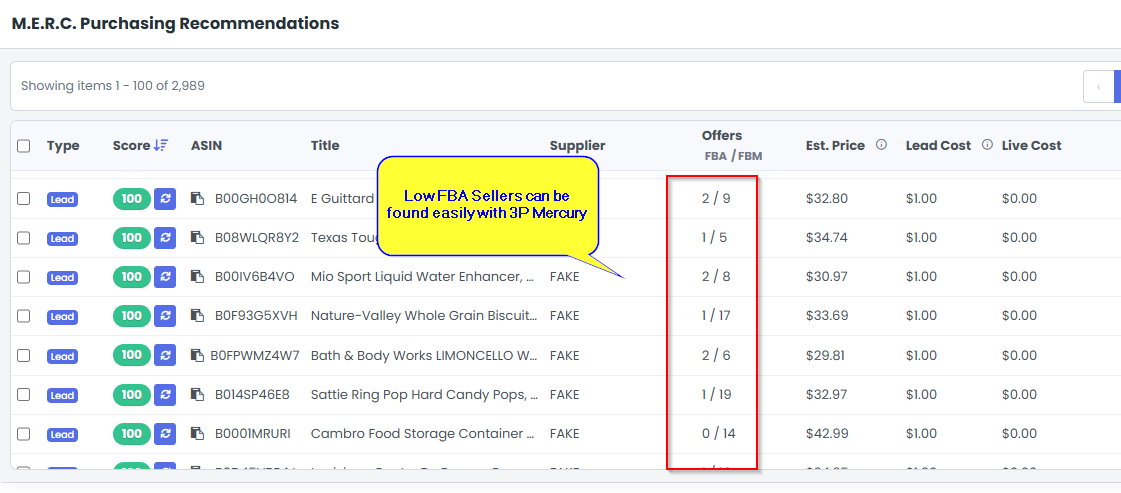
The two supplied screenshots demonstrate two different ways to revisit timing:
- Lead Vault can find products where sellers are leaving.
- Merc can simplify purchasing review by surfacing low-FBA opportunities.
The larger and cleaner your funnel becomes, the more useful these filters become. A low-FBA filter against 100 random leads may reveal nothing. The same filter against tens of thousands of validated products can uncover opportunities regularly.
Organize the database as it grows
Use tags and consistent supplier names so you can quickly retrieve:
- Products from a retailer running a sale
- Seasonal products approaching their buying window
- Full-retail replenishments
- Sale-only products
- Opportunity leads
- Products assigned to a sourcing team member
When a supplier announces a promotion, filter that supplier's saved products and recalculate them. This is much faster than beginning the sourcing process after the sale has already started.
Turn funnel growth into a business habit
Choose measurable targets that favor quality over raw volume.
A weekly sourcing scorecard might include:
- Qualified leads added
- Percentage with exact supplier matches
- Duplicate or mismatch rate
- Products reviewed for purchase
- Leads purchased
- Replenishable products discovered
- Profit generated over time
Do not reward a sourcing team only for adding the most ASINs. That encourages people to dump unvalidated files into the database. Measure whether the leads are usable.
Review rejected and losing products too. They can reveal:
- An SOP step that needs clarification
- A supplier that creates repeated mismatches
- A category with weak margins or high returns
- A risk signal the team is missing
- A sourcing method that produces low-quality leads
If you are ready to expand capacity, the guide on hiring a virtual assistant for Amazon sourcing explains how to test and train a sourcing VA.
The habit is simple:
Add qualified possibilities before you need them.
Do that every day, and losing one brand, supplier, or profitable ASIN becomes an inconvenience instead of a business emergency.
Frequently Asked Questions
How many leads should be in an Amazon lead funnel?
There is no universal number. The goal is to maintain enough validated products that restrictions, stock-outs, and changing competition do not leave you without buying options. Quality matters more than reaching a large headline number.
Should I save a lead that is not profitable?
Yes, when it has demand, an exact product match, and a credible source. Save it for future supplier discounts, lower competition, Amazon stock-outs, or higher selling prices.
What makes a qualified Amazon lead?
A qualified lead has demonstrated demand, an exact supplier match, a credible source, known eligibility, and understood risks. It does not need to meet your purchasing profit threshold yet.
How often should I add new leads?
Add qualified leads consistently, ideally every sourcing day. A practical routine divides sourcing time between filling the funnel and finding products to buy now.
How does 3P Mercury help manage a lead funnel?
3P Mercury tracks saved leads and helps filter them by changing conditions such as seller count, FBA competition, Amazon presence, cost, profit, and sales velocity.
Keep Qualified Leads Flowing
Sign up for 3P Mercury to simplify your business. The one software that takes you from sourcing to shipping, automated with the power of AI.
Sign up for 3P Mercury