Some of your best leads may already be sitting in your database.
Not because they looked amazing the first time you found them. Not because every supplier price was perfect. And definitely not because Amazon politely sent you a note saying, "Hey, this one is ready now."
They may be good now because the market changed.
Seller counts drop. FBA offers disappear. A product that looked crowded three months ago may suddenly have one FBA seller, zero FBA sellers, or a buy box that is finally moving up. That is where old leads can turn from trash into gold.

The trick is knowing how to find those changes without manually opening every product like it is 2014 and you have a lot of emotional stamina.
3P Mercury helps by tracking your leads over time, then letting you filter for opportunity signals like decreasing competition and low FBA presence. Instead of only asking, "What new leads can I find today?" you can also ask, "What old leads became interesting again?"
Why Old Leads Deserve A Second Look
A lead database should not be a storage closet. It should be a living opportunity engine.
When you first add a product to your Lead Vault, it may not be worth buying. Maybe too many sellers were on the listing. Maybe the buy box was low. Maybe the source price was not great. Maybe Amazon was selling it. Maybe it was simply not the right time.
But Amazon listings change constantly.
Over time, sellers can run out of stock, abandon the product, miss a replenishment window, lose interest, or move on because the sale they relied on disappeared. When that happens, the same listing may become more attractive.
That is especially true when FBA competition drops. A product with plenty of FBM sellers but very few FBA sellers can be a strong opportunity because Prime buyers often value speed and convenience. You do not always need to match the cheapest FBM offer. If you are one of the only FBA sellers, you may be able to price higher and still get sales.
That is the gold: not a brand-new product, but a changed market.
Start With Decreasing Competition
One of the simplest ways to find opportunity buys is to look for listings where seller count is trending down.
In Keepa, this often shows up as a seller-count line that slopes lower over time. In 3P Mercury, you can use filters in Merc or the Lead Vault to look for that same idea inside your own data.
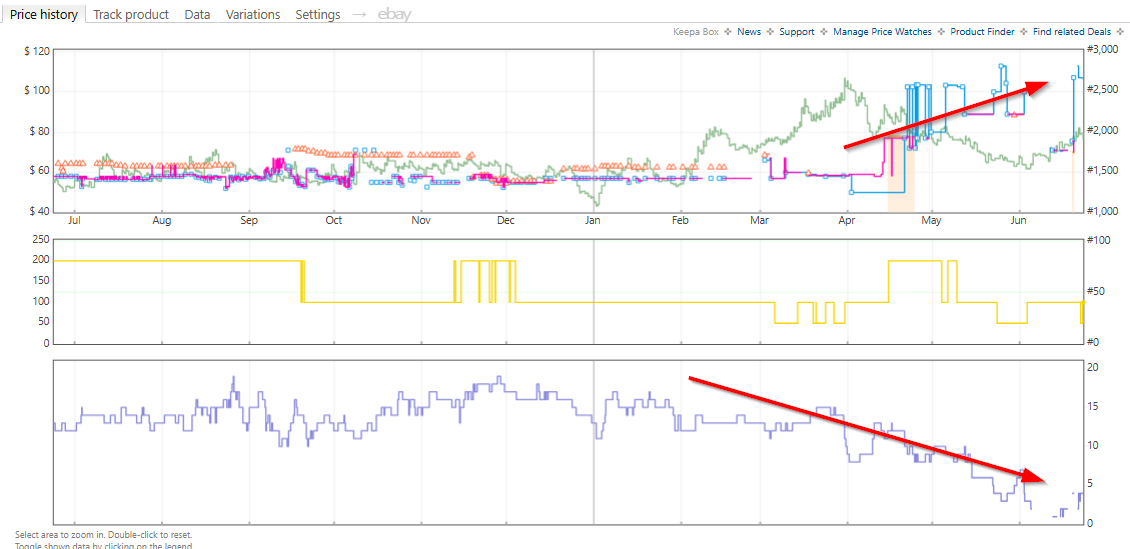
The goal is not to find a perfect product immediately. The goal is to surface products where competition is leaving.
Useful signals include:
- Seller count decreasing over 30, 90, or 180 days
- FBA offer count dropping
- Amazon not currently selling
- You are not gated
- Sales velocity is still present
- Price is stable or rising
- The product is not seasonal, meltable, or otherwise risky for the current buying window
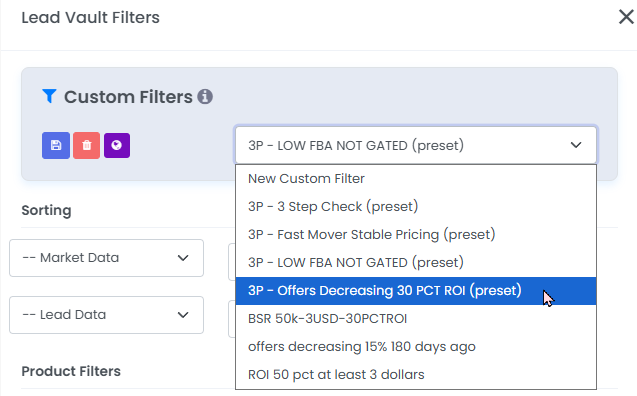
This kind of filter is powerful because it does not assume a lead is good just because it was imported. It asks whether the listing has improved since the last time you looked.
Most sellers keep chasing the front door: new leads, new lists, new searches, new storefronts. That matters, but it is not the only place opportunity lives. Sometimes the back room is full of products everyone else forgot to check again.
Look For Low FBA Presence
Low FBA presence is one of the best "wait, why is nobody here?" signals.
If a listing has healthy sales but only one or two FBA sellers, it deserves a closer look. If it has plenty of FBM sellers and no FBA sellers, it may deserve an even closer look.
In 3P Mercury, you can review this in Merc purchasing recommendations or in the Lead Vault. Merc gives you a clean way to scan products and see FBA/FBM offer counts at a glance.
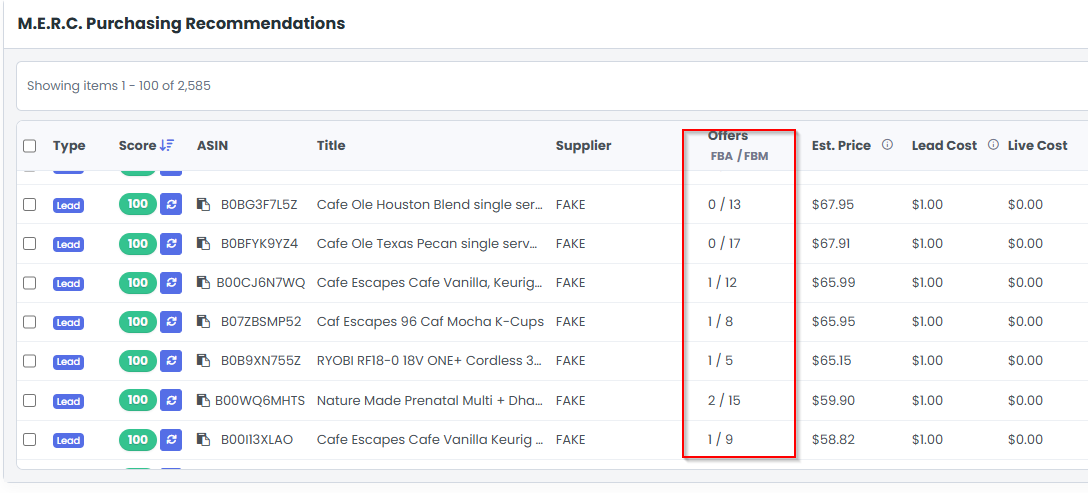
When you find a low-FBA listing, do not blindly trust the first profit number on the screen. Use it as a starting point.
Check:
- Is the product the same pack size and variation?
- Does the UPC match your validation rules?
- Is the brand legitimate, or is it a generic listing?
- Is Amazon on the listing now?
- Are there expiration-date issues?
- Is the listing meltable or seasonal?
- Can you source it without spending 20 minutes chasing one strange pack size?
If you cannot find the source in a minute or two, move on. There are more leads. Do not turn one maybe-product into a research cave.
Do Not Worship The Current Buy Box
One of the big mistakes sellers make with low-competition listings is pricing too timidly.
If there are many sellers and the buy box is stable, you probably need to be tighter with pricing. But when FBA competition is very low, the current buy box is not always the ceiling.
If the only cheap offers are FBM, and you can sell FBA, you may be able to price above them. If there is one FBA seller and that seller is already pricing higher, that may tell you something. They may understand that they do not need to compete with every merchant-fulfilled offer.
This does not mean you should price absurdly. It means you should think.
Ask:
- What are FBA sellers actually charging?
- How many units does the product sell per month?
- How many FBA sellers are splitting that demand?
- Is the price already rising as sellers leave?
- Can you test a small quantity before going heavier?
A product that looked mediocre at the old buy box may look great if the FBA market has thinned out and the realistic selling price is higher.
Use Lead Vault Filters For More Control
Merc is useful when you want fast scanning. Lead Vault is useful when you want more control over the exact filter logic.
For example, you may want to build a filter for:
- Not gated
- FBA offers less than or equal to two
- Total offers greater than five
- Amazon not selling
- No meltables during meltable season
- Excluded categories you do not want to review
- A minimum sell price, profit, or ROI
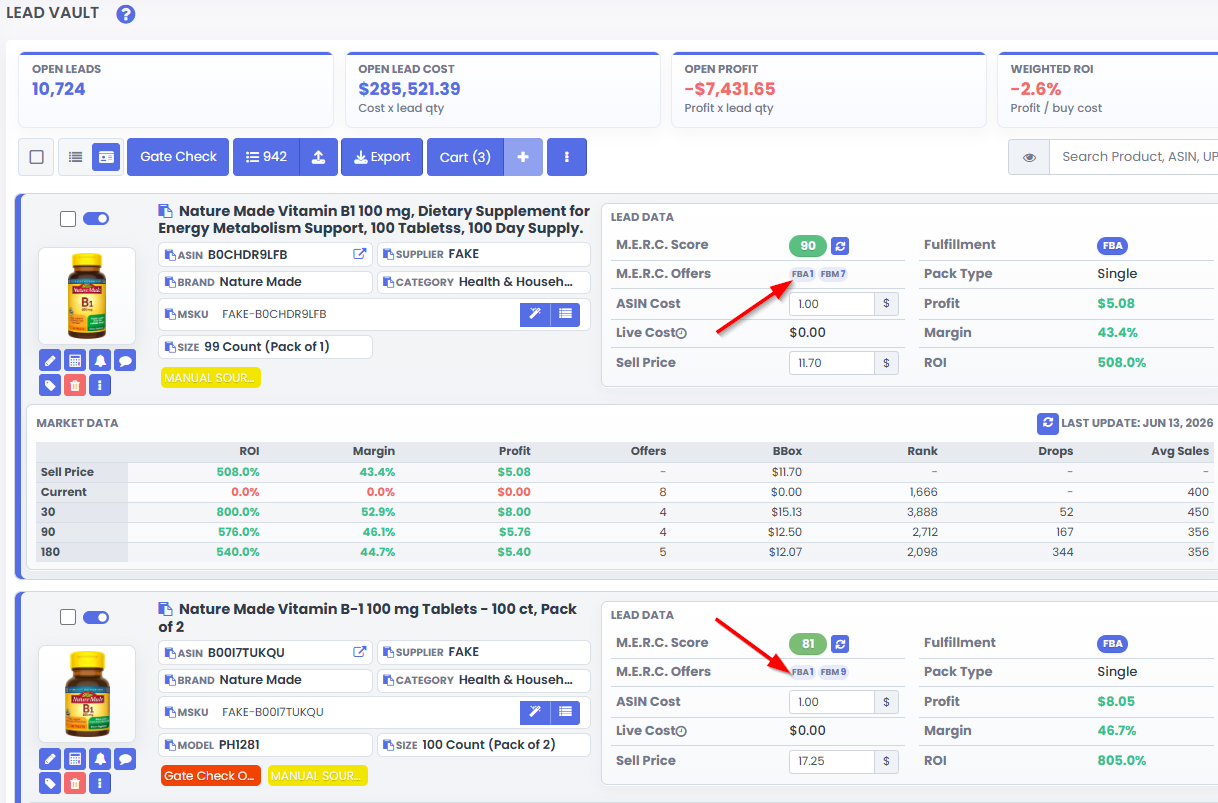
The point is not to create 100 preset filters. That becomes its own form of clutter. Start with a few filters you actually use, then save the ones that consistently surface good review candidates.
From there, open the product, check the offer structure, review the chart, search for a source, validate pack size, estimate a realistic FBA price, and decide whether to test.
This is not fully automatic. It still requires judgment. But the software does the heavy lifting of finding the pile worth looking through.
Watch Out For False Gold
Not every low-competition listing is a good buy. Some products have low FBA competition for a reason.
Be especially careful with:
- Grocery products with short expiration dates
- Meltables during warm months
- Generic-brand listings
- Pack-size mismatches
- Invalid or mismatched UPCs
- Questionable sources
- Items where you cannot verify the exact variation
For grocery, retail and wholesale often give you more control because you can check expiration dates or request minimum dating from a supplier. Online arbitrage grocery can work, but you have less control. If a supplier sends product with one month left, congratulations, your warehouse may now have snacks.
That is not the business model we are aiming for.
A Simple Workflow To Try
- Open Merc purchasing recommendations or Lead Vault.
- Filter for decreasing competition or low FBA presence.
- Add "not gated" and "Amazon not selling" if those matter to your rules.
- Remove risky categories, meltables, or generic listings when needed.
- Sort by score, sales velocity, sell price, ROI, or profit.
- Review one lead at a time.
- Check the source quickly.
- Validate pack size, UPC, brand, and expiration risk.
- Estimate a realistic FBA selling price, not just the cheapest FBM price.
- Test small before buying deep.
You are not trying to source every lead. You are trying to find the few that changed enough to matter.
Related Reading
Once you surface a possible winner, use the guide to evaluate the lead manually and with 3P Mercury. Then follow the organized workflow for purchasing inventory effectively.
FAQ
How can old Amazon leads become profitable later?
Old leads can become profitable when market conditions change. Seller counts may drop, FBA offers may disappear, Amazon may leave the listing, or prices may rise after competition decreases.
What does low FBA competition mean?
Low FBA competition means there are few Prime/FBA sellers on a listing. If demand is still strong, an FBA seller may be able to price higher than merchant-fulfilled offers and still win sales.
What should I check before buying a low-competition product?
Check sales velocity, FBA and FBM offer counts, Amazon presence, pack size, UPC, brand, expiration risk, meltable risk, and whether you can source the exact product reliably.
Should I always match the current buy box?
No. On low-FBA listings, the current buy box may be set by FBM sellers or old pricing. Review what FBA sellers are charging and decide whether a higher FBA price is realistic.
Final Thought
Turning trash into gold does not mean every bad lead becomes good.
It means your old leads are not dead just because they were not worth buying the first time. If 3P Mercury keeps tracking them, you can revisit them when the market changes.
Seller counts drop. FBA sellers disappear. Prices move. Opportunities open up.
That is the quiet advantage of a real lead database: it does not just store what you found. It helps you notice what changed.
Find More Opportunities In Your Leads
Sign up for 3P Mercury to simplify your business. The one software that takes you from sourcing to shipping, automated with the power of AI.
Sign up for 3P Mercury